

How to Heal Abandonment Issues With Inner Child Therapy
Many clients come to therapy feeling a deep fear of being left, rejected, or forgotten.
They might ask:
“Why do I get so anxious when someone pulls away?”
“Why do I feel like people will eventually leave me?”
For many people, the answer lies in the inner child.
The inner child often carries a fear of abandonment when love, attention, or presence felt inconsistent growing up. When a child experiences emotional distance, unpredictability, or disconnection from caregivers, a younger part of the psyche learns that closeness is not guaranteed.
The inner child might feel:
“I hope they don’t leave.”
“I hope they still love me.”
“I hope I haven’t done something wrong.”
Over time, this creates a deep sensitivity to any sign of distance or withdrawal.
For a child, connection equals safety. If that connection feels unstable, the nervous system adapts by becoming hyper-aware of potential loss.
This isn’t weakness, it’s survival.
But these patterns don’t just disappear with age.
They often show up in adult relationships as anxiety, overthinking, people-pleasing, or a strong need for reassurance. Even small shifts in someone’s behaviour can trigger that younger part that once felt unsafe or unsure.
This is where the inner adult becomes essential.
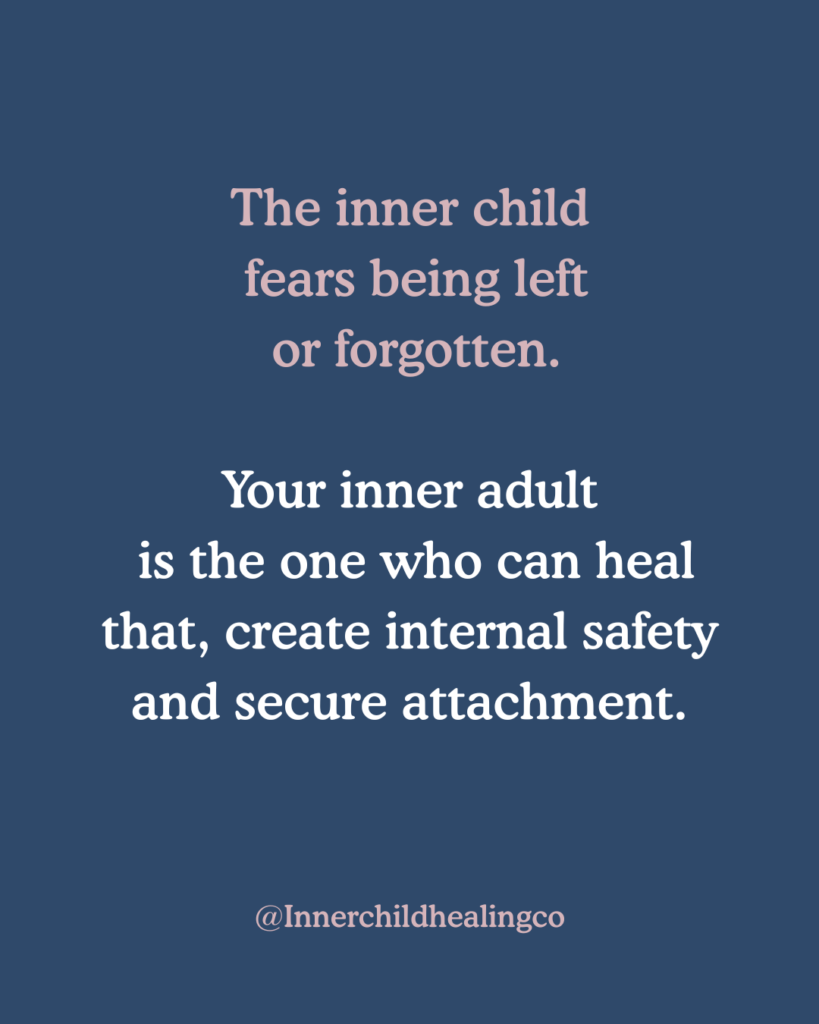
The inner adult is the part of you that can begin to create the safety that once felt uncertain. It reassures, grounds, and supports the inner child instead of abandoning it.
Healing isn’t about getting rid of the fear. It’s about no longer leaving yourself when that fear shows up.
How to Heal Abandonment issues by Understanding Your Parts
When exploring how to heal abandonment issues, it’s important to recognise that your reactions come from different parts of you trying to help.
Often they’re trying to protect you from experiencing further pain and hurt.
If you’re wondering how to heal abandonment issues, the first step is not to fix yourself but to understand yourself.
This is why, it’s helpful to go into inner child therapy with a curious mindset, as opposed to a fixer mindset.
Often, these parts are trying to protect you from experiencing more pain, rejection, or emotional hurt.
If you’re wondering how to heal abandonment issues, the first step is to practice co-regulation with yourself.
Co-Regulation and the Role of the Inner Adult
When learning how to heal abandonment isssues, it’s important to understand the difference between self-care and co-regulation.
There are many gentle ways to connect with your inner child through inner child activities and inner child exercises such as hobbies, creativity, rest, and nurturing routines. These can be really supportive when you are feeling calm or grounded.
But when you are emotionally triggered and shift into a younger, more vulnerable state, those tools often are not enough.
This is where co-regulation becomes essential.
As children, we rely on others to help us regulate our emotions. When that support is inconsistent or missing, the nervous system can struggle to settle during moments of distress.
As adults, part of how to heal abandonment isssues is learning how to offer that co-regulation to yourself through your inner adult.
Your inner adult becomes the steady, reassuring presence that your inner child needed.
In moments of big emotions, instead of trying to shut the feeling down, you can begin to respond internally in a supportive and grounding way.
You might say:
“It’s okay to cry when you’re sad.”
“I can see why you feel angry.”
“I’m here with you, you’re not alone.”
“Are you feeling scared? I’ve got you.”
“Don’t give up, we can figure this out together.”
This is not about dismissing your feelings or rushing past them. It is about staying with yourself through them.
This is how to heal abandonment isssues at a nervous system level.
You are no longer leaving yourself in moments of distress. You are learning to stay, support, and guide yourself through difficult emotions in the same way a safe and attuned caregiver would.
Over time, this builds a deeper sense of internal safety, trust, and emotional resilience.
Before going straight into healing the inner child, it is important to first get to know the protectors that have been working hard to keep you safe.
The Power of a Curious Mindset in Healing
When thinking about how to heal abandonment issues, it can be helpful to pause and ask yourself what mindset you are bringing into the process.
Many people naturally enter healing with a fixing mindset.
This can sound like, “I need to sort this out” or “I should not feel like this.” It often involves analysing thoughts, trying to control emotions, or pushing feelings away.
A curious mindset is different.
It sounds more like:
“What is happening for me right now?”
“What emotions are present?”
“Is this sadness, frustration, or anger?”
“What do I notice in my body?”
You might begin to notice sensations like a tight chest, shallow breathing, or restlessness.
This shift into curiosity is a key part of how to heal abandonment issues because it helps you reconnect with your emotional world without feeling emotionally overwhelmed.
For many people, there has been a long history of needing to numb or disconnect from feelings. These were protective strategies that helped the inner child cope with overwhelming experiences.
But over time, this can make it harder to recognise and process emotions.
Healing often involves gently unlearning this pattern and allowing yourself to feel again in a safe and supported way.
Your emotions are not the problem. They are signals.
And learning to stay present with them, rather than push them away, is an essential part of how to heal abandonment issues.
Before going straight into healing the inner child, it is important to talk about protectors.
The Importance of Getting to Know Protectors First
A common mistake when learning how to heal abandonment issues is trying to access the inner child too quickly.
Protectors are the parts of you that developed to prevent you from feeling the full pain of abandonment. These might show up as anxiety, overthinking, avoidance, people-pleasing, or emotional shutdown.
If you’re serious about how to heal abandonment issues, you need to build trust with these parts first.
Protectors do not trust easily. They have been working hard for years to keep you safe.
When you rush past them, they often become louder.
When you slow down and listen, something begins to shift.
Example: Befriending an Anxious Part
A key step in how to heal abandonment issues is learning to relate to your anxiety differently.
Instead of asking, “How do I stop feeling this way?” try asking, “What is this anxious part trying to protect me from?”
You might notice a tight chest, racing thoughts, or a need for reassurance.
Rather than pushing it away, you can say internally, “I see you. I know you’re trying to help.”
This is how to heal abandonment issues in a way that builds internal trust.
When the anxious part feels heard, it begins to soften.
Underneath it, there is often something more vulnerable.
Witnessing and Reparenting the Abandoned Inner Child

At the core of how to heal abandonment issues is the ability to gently witness the part of you that felt left, unseen, or unimportant.
This is the inner child.
Once protectors feel safe enough, you can begin to connect with this younger part by noticing when it shows up, validating its feelings, and offering reassurance.
You might say, “You didn’t deserve to feel alone.”
“I’m here with you now.”
“You’re not being left anymore.”
This process is known as reparenting.
If you are exploring how to heal abandonment issues, this is where real change begins, not by changing others, but by becoming the consistent presence you needed.
How IFS Therapy Helps Heal Abandonment
Internal Family Systems therapy offers a powerful approach to how to heal abandonment issues because it understands the mind as made up of different parts.
In this model, protectors try to keep you safe, while exiled parts such as the inner child carry emotional pain. The Self is your grounded inner adult that can lead with calm and compassion.
When learning how to heal abandonment issues through this approach, you are not forcing change. You are creating connection.
You begin to build relationships with your parts, listen instead of suppress, and respond with compassion instead of fear.
This is why it can be so effective for how to heal abandonment issues.
The Antidote: Inner Child Therapy and Secure Internal Attachment
If you have been exploring how to heal abandonment issues, one of the most important shifts is understanding that healing comes from within.
The goal is not to find people who never trigger you. The goal is to become someone who can stay with yourself when you are triggered.
This is where inner child therapy becomes so important.
When working on how to heal abandonment issues, many people focus on relationships or external reassurance. Lasting change happens when your internal world begins to feel safe and consistent.
Inner child therapy helps you reconnect with the part of you that felt left or uncertain and meet that part with presence.
At the same time, developing the inner adult allows you to stay grounded, offer reassurance, and create stability within yourself.
Over time, this builds a secure internal attachment.
You begin to trust that you can handle emotional moments, that you will not leave yourself, and that you are able to create safety from within.
This is how to heal abandonment issues at a deeper level.
It is not about never feeling fear again. It is about having a steady internal relationship that can hold that fear when it arises.
Inner child therapy, supported by a strong inner adult, creates a new pattern where connection feels more stable because it is rooted internally.
A Gentle Reminder
If you have been searching for how to heal abandonment issues, remember this.
You are not too much.
You are not too sensitive.
Your system adapted in the best way it could.
Healing is not about becoming someone new.
It is about reconnecting with the parts of you that had to carry too much, too early.
And learning how to heal abandonment issues means you no longer leave yourself when it matters most.
Curious to go deeper?
Hey, I’m Vicky. I offer inner child therapy for those who want to heal early wounds, release C-PTSD patterns, work through fear of abandonment, and build a strong sense of internal safety and secure attachment.
If you’re ready to go deeper and create more emotional stability in your life, I currently have availability for new clients in-person in Newcastle, UK and online.
Feel free to get in touch to arrange a consultation.
Read More
Inner Child Healing: 12+ Powerful and Practical Tools
Is Inner Child Work Evidence-Based? How Memory Reconsolidation Heals Childhood Trauma
9 Inner Child Work Questions to Soothe Emotional Pain
IFS Self Abandonment, CPTSD, and Codependency: How We Learned to Leave Ourselves to Stay Safe
Internal Family Systems Abandonment Work – Healing Early Wounds with Compassion