Inner Child Work

  • Inner Child Work Practitioner: Guiding Your Journey to Healing

    inner child work practitioner inner child work inner child therapy inner child therapist icw2

    Inner Child Work Practitioner: Guiding Your Journey to Healing

    An inner child work practitioner plays a vital role in helping adults reconnect with, understand, and nurture the parts of themselves that carry early wounds. Childhood experiences, such as neglect, trauma, or inconsistent caregiving leave lasting imprints on our emotions, beliefs, and behaviors. These early experiences often create patterns of self-doubt, fear, and unmet needs that can persist into adulthood.

    Working with an inner child work practitioner provides guidance, support, and a safe space to explore these patterns. Using tools such as Internal Family Systems (IFS) therapy, practitioners help individuals identify vulnerable parts, protective parts, and the dynamics that have shaped their emotional world. This blog explores the role of an inner child work practitioner, the methods they use, and how working with one can transform your relationship with yourself.

    What an Inner Child Work Practitioner Does

    An inner child work practitioner specializes in supporting adults in healing emotional wounds from childhood. Their work focuses on helping you:

    • Recognize patterns of behavior and belief rooted in childhood experiences
    • Connect with the inner child and understand their needs
    • Identify protective parts that may block growth or self-compassion
    • Release old emotional burdens through guided interventions

    They serve as a guide, creating a safe environment for exploration, understanding, and growth. Through their guidance, you can begin to untangle longstanding patterns of self-criticism, anxiety, or relational difficulties.

    The Role of IFS in Inner Child Work

    Internal Family Systems (IFS) therapy is a cornerstone of modern inner child work. An inner child work practitioner often uses IFS to:

    • Identify distinct parts within you, including vulnerable, protective, and critical parts
    • Help you communicate with these parts safely and effectively
    • Facilitate unburdening and releasing old emotions, beliefs, and pain carried by these parts
    • Integrate new capacities for self-care, self-compassion, and emotional resilience

    IFS allows the practitioner to guide you in a nonjudgmental way, ensuring that all parts of your internal system are acknowledged, understood, and healed.

    Who Can Benefit from an Inner Child Work Practitioner?

    Anyone struggling with unresolved childhood wounds can benefit from working with an inner child work practitioner. Common experiences that bring clients to these practitioners include:

    • Feelings of emptiness, low self-worth, or inadequacy
    • Repetitive relational patterns, especially codependency
    • Anxiety, depression, or chronic self-criticism
    • Difficulty setting boundaries or expressing needs
    • Emotional triggers that feel disproportionate to current circumstances

    By addressing these issues at the level of the inner child and the parts that protect them, an inner child work practitioner helps individuals move toward emotional freedom and resilience.

    Step 1: Awareness and Assessment

    The first step in working with an inner child work practitioner is awareness. The practitioner helps you identify which patterns, beliefs, and behaviors are rooted in your early experiences.

    This process includes:

    • Exploring family dynamics and childhood experiences
    • Identifying recurring emotional patterns
    • Noticing how protective parts influence your thoughts and actions
    • Recognizing unmet needs that continue to affect adult life

    Awareness is foundational because it allows you to distinguish between automatic, survival-based behaviors and authentic, adult responses.

    Step 2: Connecting with the Inner Child

    Once patterns are recognized, the inner child work practitioner guides you in connecting with your inner child. This step may involve:

    • Visualization exercises to meet and speak with the inner child
    • Journaling letters to or from the inner child
    • Imagining scenarios where your inner child’s needs are met safely

    This connection is essential for fostering trust, understanding, and emotional validation. It forms the basis for healing and empowers you to reparent yourself in ways that were not possible in childhood.

    Step 3: Working with Protective Parts

    Protective parts often develop in response to childhood experiences. An inner child work practitioner helps you identify these parts, which may include:

    • The inner critic, enforcing harsh self-judgment
    • The caretaker, prioritizing others’ needs over your own
    • The anxious part, constantly scanning for potential threats

    Using IFS therapy, the practitioner facilitates dialogue between these parts and the self, helping them understand that their protective strategies were adaptive in childhood but are no longer needed. This fosters internal cooperation rather than conflict.

    Step 4: Unburdening Old Wounds

    One of the most transformative aspects of working with an inner child work practitioner is unburdening—the release of old emotional pain. This step often involves:

    • Exploring feelings of shame, fear, or grief
    • Acknowledging unmet needs from childhood
    • Helping parts release the burdens they carry

    Unburdening allows the inner child and protective parts to step back from reactive patterns and creates space for self-compassion and growth.

    Step 5: Reparenting and Self-Care

    A critical stage in the work with an inner child work practitioner is reparenting. This involves giving your inner child the care, attention, and validation that may have been missing.

    Reparenting strategies include:

    • Providing consistent reassurance and safety
    • Establishing healthy boundaries
    • Nurturing creativity, play, and curiosity
    • Affirming that your needs and feelings are valid

    This stage helps shift your internal system from survival-focused caretaking to balanced self-care, teaching you to meet your own needs instead of seeking them solely through others.

    Step 6: Integration and Daily Practice

    After connection, unburdening, and reparenting, the inner child work practitioner guides you in integrating these changes into daily life. This includes:

    • Practicing mindfulness and self-reflection to maintain internal harmony
    • Responding to triggers with awareness rather than reactivity
    • Reinforcing boundaries and self-care routines
    • Cultivating resilience, self-compassion, and emotional regulation

    Integration ensures that healing is sustainable and that your inner child feels consistently supported.

    Stage 7: Healing Relational Patterns

    Many adults seek an inner child work practitioner to address recurring relational patterns. By exploring how childhood experiences influence adult relationships, practitioners help you:

    • Recognize codependent or enabling behaviors
    • Understand why you may be drawn to certain types of partners
    • Heal attachment wounds that contribute to anxiety, fear, or self-doubt
    • Build healthier, more balanced relationships

    This relational focus complements inner child healing, allowing for deeper emotional freedom.

    Stage 8: Long-Term Growth and Resilience

    The work with an inner child work practitioner doesn’t end after a few sessions. True transformation involves long-term growth:

    • Continuing dialogue with inner child and protective parts
    • Maintaining practices of self-care and self-compassion
    • Revisiting old patterns with curiosity and awareness
    • Building emotional resilience and authentic self-expression

    This ongoing process ensures that the inner child remains nurtured and integrated into adult life.

    Benefits of Working with an Inner Child Work Practitioner

    inner child work practitioner inner child work inner child therapy inner child therapist icw1

    The benefits of engaging an inner child work practitioner include:

    • Increased self-awareness and emotional understanding
    • Reduced anxiety, depression, and self-criticism
    • Healthier relationships with others and yourself
    • Greater capacity for self-care, joy, and creativity
    • Healing of long-standing childhood wounds and trauma

    Working with a skilled practitioner allows you to navigate complex emotions safely and efficiently, providing guidance and support as you uncover and nurture vulnerable parts of yourself.

    How IFS Therapy Enhances Inner Child Work

    IFS therapy is a powerful tool in the toolkit of an inner child work practitioner. It helps:

    • Identify distinct internal parts and their roles
    • Facilitate communication and cooperation among parts
    • Release burdens of shame, fear, and trauma
    • Integrate new capacities for emotional regulation and self-care

    By addressing both the inner child and protective parts, IFS supports holistic healing and empowers clients to cultivate a compassionate, resilient relationship with themselves.

    Final Reflection

    An inner child work practitioner offers guidance, expertise, and a safe space to explore, understand, and heal the emotional wounds carried from childhood. Through methods like IFS therapy, practitioners help clients recognize protective parts, connect with the inner child, unburden old pain, and integrate self-care into daily life.

    The journey of inner child healing is profound. With the support of an experienced practitioner, you can reclaim emotional freedom, strengthen self-compassion, and build resilience that enhances all areas of life.

    Curious to Begin Your Inner Child Work Journey?

    If you are ready to explore your inner child, understand the parts of yourself that carry old wounds, and cultivate lasting self-compassion, you’re welcome to get in touch. Working with an inner child work practitioner can help you safely navigate the healing process, release the burdens of childhood trauma, and integrate capacities for self-care, emotional resilience, and authentic living.

    Your inner child is waiting to be seen, heard, loved, and your journey can begin today.

    Read More

    Healing from Within: A Deep Dive into Inner Child Work Psychotherapy

    Is Inner Child Work Evidence-Based? How Memory Reconsolidation Heals Childhood Trauma

    9 Inner Child Work Questions to Soothe Emotional Pain

    Therapy For Healing Inner Child

    Reparenting the Wounded Inner Child: A Deep Journey Into Inner Healing Through IFS

  • Parent Your Inner Child: Steps to Nurture, Heal, and Reclaim Your Emotional Self

    parent your inner child inner child work inner child therapist inner child therapy 2

    Parent Your Inner Child: Steps To Nurture, Heal, and Reclaim Your Emotional Self

    Learning to parent your inner child is a transformative practice that allows adults to provide the care, guidance, and emotional support they may have missed in childhood.

    Many of us carry wounds from neglect, emotional unavailability, or trauma, and these early experiences often show up as self-doubt, anxiety, perfectionism, or difficulties in relationships.

    To parent your inner child is to reconnect with those vulnerable parts of yourself and create a safe internal environment. Through approaches like Internal Family Systems (IFS) therapy, you can identify both the protective and vulnerable parts of yourself, heal old wounds, and integrate self-compassion and emotional resilience into daily life.

    Understanding the Need to Parent Your Inner Child

    As children, many of us learned that our feelings didn’t matter, that our needs were secondary, or that vulnerability was risky. These experiences leave imprints that shape adult life, creating inner conflicts between parts that desire care, love, and acceptance and parts that developed survival strategies, such as the inner critic, caretaker, or anxious protector. Learning to parent your inner child allows these parts to feel seen, safe, and supported. It is not about fixing yourself but about providing the nurturing you once lacked.

    Awareness: Recognising Your Inner Child

    The first step in parent your inner child work is awareness. It involves noticing the moments when old patterns arise—when triggers provoke strong emotional reactions, when self-criticism takes over, or when you find yourself constantly trying to please others. These reactions are often signals from your inner child, seeking attention, care, and recognition. Awareness is the doorway to connection, creating the opportunity to respond rather than react.

    Connecting with Your Inner Child

    Once you notice these patterns, the next step in parent your inner child work is establishing a connection with the vulnerable, authentic part of yourself. This involves creating a mental space where your inner child feels safe to express feelings that may have been suppressed for years. You may imagine comforting them, listening attentively to their fears and needs, or simply acknowledging their presence. In these moments, your inner child begins to feel seen, which fosters trust and lays the foundation for deeper healing.

    Understanding Protective Parts

    Alongside the inner child are protective parts, often formed in response to early experiences of neglect, criticism, or unpredictability. These parts, such as the inner critic, the anxious protector, or the caretaker, were adaptive in childhood but may now limit growth or self-compassion. Learning to parent your inner child involves recognizing these protective parts, understanding their intentions, and gradually helping them release burdens they no longer need to carry. By creating dialogue between the inner child and these protective parts, you begin to cultivate an internal environment of safety and cooperation.

    Providing Safety and Reassurance

    A key part of learning to parent your inner child is creating a sense of safety. Your inner child may have grown up feeling vulnerable or unprotected, and now it’s your role as the adult self to provide consistent reassurance. This can mean responding gently to strong emotions, offering internal comfort, or simply acknowledging that it is okay to feel what you feel. Repeated experiences of safety gradually teach your inner child that it is no longer alone and that its emotions and needs are valid.

    Emotional Validation

    Many adults never received validation in childhood, and a central step in parent your inner child work is offering it to yourself. Emotional validation means recognizing and accepting feelings as they arise without judgment. Whether it is anger, sadness, fear, or joy, allowing yourself to fully feel these emotions nurtures your inner child and strengthens the bond between your adult self and your vulnerable parts. This validation is transformative, replacing messages of shame and inadequacy with understanding and care.

    Meeting Unmet Needs

    Parenting your inner child also involves identifying and meeting the needs that were not fulfilled in the past. Perhaps your inner child longed for attention, comfort, play, or safety. By consciously offering these forms of care as an adult, you teach your inner child that it is now safe to rely on your presence. This act of self-nurturing breaks old cycles of seeking validation externally and reinforces the message that your worth is inherent.

    Reparenting Through IFS Therapy

    parent your inner child inner child work inner child therapist inner child therapy 1

    IFS therapy is particularly effective for learning to parent your inner child because it allows you to explore and communicate with both vulnerable and protective parts safely. Through IFS, you can identify parts that carry shame, fear, or trauma, and guide them toward releasing burdens that no longer serve them. The process creates internal harmony, ensuring that your inner child and protective parts cooperate rather than conflict. Over time, this strengthens your ability to care for yourself consistently, reducing the need to seek validation or care from external sources.

    Integration of Play, Joy, and Creativity

    Parenting your inner child is not solely about addressing wounds—it is also about fostering growth, joy, and expression. Engaging in playful activities, creative expression, or simple moments of curiosity nurtures the inner child and reminds them that life can be safe and enjoyable. Incorporating these experiences into daily life reinforces emotional balance and promotes lasting resilience.

    Establishing Boundaries and Practicing Self-Care

    Another essential aspect of parent your inner child work is learning to set boundaries and prioritize self-care. By acknowledging your limits and responding to your needs, you demonstrate to your inner child that it is protected and valued. Over time, these practices reduce the influence of critical or anxious parts, allowing your inner child to feel secure within itself and your adult self to operate from a place of awareness and self-respect.

    Sustaining Healing and Growth

    Healing is not linear, and the journey to parent your inner child requires ongoing attention and practice. Regular reflection, revisiting IFS practices, and maintaining self-care routines help ensure that your inner child remains nurtured. This ongoing commitment fosters emotional resilience, strengthens your internal system, and allows you to navigate challenges with greater ease and confidence.

    The Benefits of Parenting Your Inner Child

    The long-term effects of learning to parent your inner child are profound. Adults who integrate these practices experience greater self-compassion, reduced anxiety and self-criticism, and improved emotional regulation. Relationships become healthier as you are able to respond from wholeness rather than reactivity, and you cultivate a sense of self-worth that is independent of external validation. Healing your inner child transforms not just your internal experience, but also the way you engage with the world.

    Curious to Begin Your Inner Child Work Journey?

    If you are ready to explore your inner child, understand the parts of yourself that carry old wounds, and cultivate lasting self-compassion, you’re welcome to get in touch.

    Learning to parent your inner child with the guidance of an experienced practitioner, particularly using IFS therapy, can help you safely navigate your healing journey. By releasing burdens from the past and integrating capacities for self-care, emotional resilience, and authenticity, you can transform your relationship with yourself and the world around you.

    Your inner child is waiting to be seen, nurtured, and loved—and your journey to reclaim emotional wholeness can begin today.

    Read More

    IFS Therapy Online

    Reparenting the Wounded Inner Child: A Deep Journey Into Inner Healing Through IFS

    Inner Child Healing UK

    Inner Child Healing for Parents: Reconnecting With Yourself While Raising Your Children

    Revolutionary Inner Child Therapy For Women That Protects Your Mental Health From Harmful Relationships

  • How to Heal Your Inner Child Trauma: Reclaim Your Joy and Sense of Self

    how to heal your inner child trauma inner child work inner child therapy inner child therapist i1

    How to Heal Your Inner Child Trauma: Reclaim Your Joy and Sense of Self

    Many people come to me wondering how to heal your inner child trauma. They feel stuck in patterns they don’t understand, such as overgiving in relationships, self-sabotaging, or struggling to trust themselves and others. Often, these patterns trace back to childhood experiences where their emotional needs weren’t met, and the strategies they developed to survive became the same habits that now hold them back.

    Healing your inner child is not about blaming your parents or caregivers. It’s about recognizing that your younger self needed love, care, and safety in ways they didn’t receive, and learning to provide that for yourself now. This is the essence of how to heal your inner child trauma. Healing starts with reaching back with compassion, validating those early feelings, and integrating them into your present life.

    Recognising the Wounds

    Inner child trauma often manifests subtly at first. You might notice a persistent self-doubt, a fear of abandonment, or a tendency to overcompensate for others’ needs while neglecting your own. Maybe you find yourself replaying old patterns. This might be people-pleasing in relationships, avoiding conflict, or constantly seeking approval.

    These patterns are echoes of the ways your younger self learned to cope. In childhood, coping mechanisms like caretaking, overthinking, and hyper-empathy were ways to survive environments that were unpredictable, neglectful, or even emotionally unsafe. Understanding this is the foundation for how to heal your inner child trauma.

    It’s not that these parts of you are wrong. They were necessary. But now, they may no longer serve you. The challenge is learning to recognize them and respond differently.

    Reconnecting with Your Younger Self

    how to heal your inner child trauma inner child work inner child therapy inner child therapist i2

    To truly understand how to heal your inner child trauma, you first need to reconnect with the part of yourself that was hurt. This is about creating space to listen without judgment, to offer comfort and understanding, and to validate emotions that may have been dismissed or ignored.

    Sometimes, reconnecting with your inner child happens in quiet moments. This might be sitting with yourself, journaling, or even visualising your younger self and imagining holding them with compassion. Other times, it arises through reflection after a triggering interaction, noticing how your reactions are tied to past experiences.

    Healing your inner child isn’t about reliving pain. It’s about reparenting yourself. You provide for yourself now what you didn’t get then: reassurance, consistency, and love. In doing so, you gradually build an internal sense of safety that wasn’t available in childhood.

    The Protective Parts We Carry

    As children, we often develop parts of ourselves that act as protectors. These parts might show up as caretaking behaviors, people-pleasing tendencies, hyper-empathy, self-doubt, or overthinking. They were survival tools. For example, a child might learn to prioritize others’ needs over their own to avoid conflict or gain approval, or to anticipate emotional withdrawal and adapt accordingly.

    Understanding these parts is central to how to heal your inner child trauma. They are not enemies. They are signals that your inner self is still protecting you. When you acknowledge their intentions, you can begin to guide them toward healthier ways of functioning in adulthood.

    Integrating the Adult Self

    how to heal your inner child trauma inner child work inner child therapy inner child therapist i3

    Healing requires a balance between your inner child and your adult self. The adult self is steady, compassionate, and capable of providing what the younger self lacked: reassurance, consistency, and emotional co-regulation. It’s the part of you that can see the bigger picture, make decisions for your well-being, and create boundaries that your younger self couldn’t enforce.

    When you strengthen this connection, you can start to respond to triggers differently. You’re no longer entirely at the mercy of old patterns. The adult self holds space for the inner child, ensuring that your emotional needs are met now rather than being unconsciously outsourced to relationships that mirror old wounds.

    This integration is a core component of how to heal your inner child trauma. It’s about learning to be both nurturing and protective, giving yourself what you didn’t receive and creating a foundation of self-trust and safety.

    Relationships and Healing

    Your inner child’s wounds often show up most clearly in relationships. You might notice patterns of seeking validation, tolerating mistreatment, or overextending yourself emotionally. By recognizing these patterns, you can start to shift how you engage with others.

    Healing your inner child trauma means learning to choose relationships that reflect respect, reciprocity, and care. It doesn’t mean avoiding all challenges, but rather refusing to replay dynamics that reinforce old injuries. Surrounding yourself with supportive people can reinforce your inner child’s sense of worth and model the kind of love and empathy that you deserve.

    Daily Practices for Healing

    While therapy is often invaluable in this work, there are also daily practices that support how to heal your inner child trauma. These practices help you reconnect with yourself and integrate your inner child’s needs into your adult life:

    • Journaling: Write letters to your younger self or explore past experiences from a compassionate perspective.
    • Creative expression: Art, music, dance, or other forms of creativity can help release emotions and reconnect with joy.
    • Mindful self-care: Regularly prioritize activities that nurture your body, mind, and spirit.
    • Visualization: Imagine holding, comforting, and reassuring your younger self during times of stress.
    • Affirmations: Speak to yourself in ways that counteract internalized messages of unworthiness.

    These practices reinforce the adult self’s ability to nurture the inner child, gradually reducing the hold of past trauma on present life.

    Signs You’re Healing

    As you engage with your inner child and strengthen your adult self, there are signs that indicate progress in how to heal your inner child trauma:

    • You experience fewer intense emotional triggers
    • You feel more grounded and present in your body
    • You can set and maintain boundaries without guilt
    • You prioritize your needs alongside the needs of others
    • You notice a growing sense of self-compassion and confidence
    • You are able to enjoy life’s pleasures without self-sabotage

    These shifts aren’t just emotional. They reflect changes in your nervous system and internalized sense of safety.

    The Role of Therapy

    While self-reflection and daily practices are essential, therapy can accelerate how to heal your inner child trauma. Approaches such as trauma-informed therapy, IFS, or inner child work provide a structured, supportive environment to explore wounds safely.

    Therapists can help you:

    • Identify protective parts and patterns
    • Strengthen your adult self
    • Process repressed or overwhelming emotions
    • Develop healthy relational patterns
    • Learn self-soothing and emotional regulation strategies

    The guidance of a trained professional can make the difference between surface-level coping and deep, lasting healing.

    Final Thoughts

    Learning how to heal your inner child trauma is a journey of compassion, courage, and patience. It’s about giving your younger self the care, attention, and validation they never received, and creating a life where your needs are honored.

    Healing is not linear. There will be setbacks, triggers, and moments of doubt, but each step you take to nurture your inner child strengthens your adult self, reinforces your boundaries, and deepens your capacity for joy and connection.

    Every moment you invest in yourself is a step toward freedom. By integrating your inner child and adult self, engaging in supportive relationships, and practicing self-compassion, you can break the cycles of old trauma and live a life of authenticity, joy, and emotional freedom.

    If you’re ready to explore how to heal your inner child trauma in a safe, supportive space, working with a trained therapist can help guide you through this transformative journey. Your inner child is waiting to be seen, heard, and held and the adult self in you is ready to provide it.

    Curious to Go Deeper?


    If you’re interested in exploring how to heal your inner child trauma more deeply, inner child therapy and Internal Family Systems (IFS) therapy can provide a supportive, structured way to do that. These approaches help you connect with your younger self, understand protective parts, and strengthen your adult self so you can finally feel safe, seen, and cared for.

    You’re welcome to get in touch to discuss whether this type of therapy might be the right fit for you. Together, we can explore your needs, your goals, and how to create a healing process that feels safe, empowering, and tailored to your journey.

    Read More

    IFS Therapy Online

    Reparenting the Wounded Inner Child: A Deep Journey Into Inner Healing Through IFS

    Inner Child Healing UK

    Inner Child Healing for Parents: Reconnecting With Yourself While Raising Your Children

    Revolutionary Inner Child Therapy For Women That Protects Your Mental Health From Harmful Relationships

  • Stop Caretaking the Borderline or Narcissist: Reclaim Your Energy and Your Life

    how to stop caretaking the borderline or narcissist inner child therapy inner child work inner child therapist therapy for narcissism abuse j1

    Stop Caretaking the Borderline or Narcissist: Reclaim Your Energy and Your Life

    Many people come to me seeking guidance on how to stop caretaking the borderline or narcissist in their lives. They often feel drained, anxious, or guilty for setting boundaries, yet they can’t seem to stop overgiving to people who don’t reciprocate or respect them. Understanding why we fall into these patterns and how to break free is the first step toward reclaiming your energy, your peace, and your sense of self.

    Understanding Why We Caretake

    Caretaking is often learned early in life. Many children grow up in homes with emotionally unavailable, controlling, or abusive parents, including narcissistic or borderline parents. In order to survive, we adapt. Magical thinking and hope become essential strategies:

    • “I hope mum will be in a good mood today.”
    • “I hope they won’t fight tonight.”
    • “I hope mum will acknowledge my feelings”

    These are not signs of weakness, they are strategies for survival. Caretaking and codependency, often rooted in this hopeful thinking, helps children feel some sense of control over an unpredictable environment.

    As children, we don’t yet have the capacity to separate our needs from the emotional instability around us.

    Over time, these early survival strategies can carry forward into adulthood, particularly in relationships with partners or family members who are emotionally unavailable or manipulative. This is why so many people struggle to stop caretaking the borderline or narcissist, because they are unconsciously repeating patterns learned in childhood.

    Signs You’re in a Relationship with a Narcissist or Borderline

    Recognizing the dynamics at play is crucial to breaking free from caretaking. Some common signs include:

    • Threats of abandonment used as control
    • Disrespect for boundaries
    • Extreme jealousy and controlling behavior
    • Monitoring your whereabouts
    • Severe emotional dysregulation
    • Coldness or emotional withdrawal
    • Guilt and emotional manipulation
    • Lack of personal responsibility for their mental health

    If you recognize these patterns, it’s a clear signal to reassess the relationship and reclaim your boundaries.

    The Origins of Caretaking and Codependency

    how to stop going back to an abusive relationship inner child therapy inner child work inner child therapist ifs therapist ifs therapy g2

    Caretaking often stems from early childhood experiences. Children adapt to unpredictable, neglectful, or abusive environments by creating protective strategies, which can persist into adulthood.

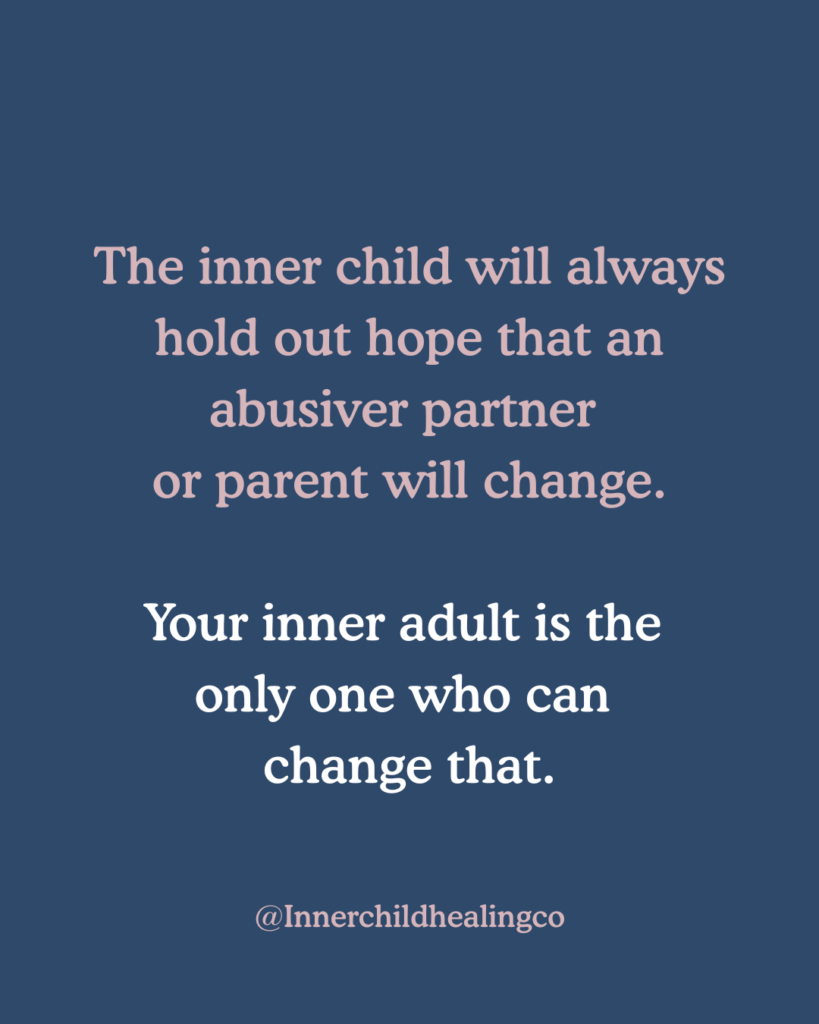
    A child’s inner world develops around hope: hope that the parent will change, hope that they will finally be seen, hope that love can be earned.

    Unfortunately, this hope can extend into adulthood, manifesting as caretaking in relationships with narcissists or borderlines.

    The inner child continues to operate with rose-colored glasses, wanting to heal or “fix” someone who cannot or will not change.

    At some point, the adult self must step in. The adult self reads the books, seeks therapy, joins support groups, and begins the conscious work of reclaiming energy, setting boundaries, and letting go of unhealthy patterns.

    Often, this awakening is triggered by a crisis. This might be another betrayal, exploitation, or letdown from the abusive parent or partner.

    For women, particularly those raised to be caretakers or people-pleasers, this can feel like unlearning a lifetime of habits.

    Many women were trained to give empathy and care even when it wasn’t reciprocated, especially if their parents were narcissistic or emotionally unavailable.

    Hyper-empathy becomes a way to compensate for the lack of care received in childhood.

    But eventually, continuing this pattern with toxic people only reinforces the same cycle.

    Putting Yourself First

    how to stop caretaking the borderline or narcissist inner child therapy inner child work inner child therapist therapy for narcissism abuse j2

    The first step to stop caretaking the borderline or narcissist is asking a simple but powerful question:

    “I want to care for them as no one cared for me the way I needed to, but who cares for me?”

    The answer is: you can be. You become the person who provides the empathy, support, and care that your neglected parts of self never received. 

    This is not selfish. It is essential. Without this internal support, it’s impossible to fully break free from caretaking cycles.

    IFS Therapy and the Mind-Body Connection

    One of the most effective tools to support this journey is Internal Family Systems (IFS) therapy. IFS helps you identify the parts of yourself that unconsciously pull you into draining or codependent relationships.

    Common protective parts include:

    • Caretaking parts that try to “fix” a narcissistic partner or parent
    • People-pleasing parts that seek approval from emotionally unavailable individuals
    • Hyper-empathetic parts that overcompensate for neglect or abandonment
    • Self-doubt parts that carry toxic shame from abusive environments
    • Overthinking parts that fear abandonment and replay past traumas

    Through IFS, you learn to acknowledge these parts, validate their intentions, and gently help them release the roles they’ve been carrying. Rather than pushing them away, you integrate these parts into a balanced self, reclaiming your energy and freedom.

    The Adult Self: Healing the Past

    how to stop caretaking the borderline or narcissist inner child therapy inner child work inner child therapist therapy for narcissism abuse j1

    A central concept in IFS is connecting with your adult self. The part of you that is stable, grounded, and capable of providing the empathy and regulation that your younger parts lacked.

    The adult self can:

    • Comfort the inner child parts that experienced neglect
    • Offer the emotional co-regulation that was missing
    • Model healthy boundaries and self-respect
    • Reassure you that your needs matter

    By building a secure attachment with your adult self, you learn to create safety internally, instead of seeking it externally from the borderline or narcissist. This internal security is foundational to breaking free from caretaking.

    Signs You’re Becoming Stronger

    As you begin to stop caretaking the borderline or narcissist, you may notice tangible shifts in your behavior and energy:

    • Drawing your energy back to yourself instead of overgiving
    • Setting and enforcing stronger boundaries
    • Trusting your intuition over hope for someone to change
    • Pushing back against controlling or manipulative behavior
    • Accepting reality rather than clinging to potential
    • Focusing your energy on your career, hobbies, health, and education
    • Letting go of the need to fix or control others
    • Prioritizing friendships and activities that genuinely energize you, like dancing, learning, or creative expression

    These changes are not just behavioural. They reflect profound internal shifts in your nervous system and sense of self-worth.

    Signs IFS Therapy Is Working

    If you are exploring IFS therapy as a tool to stop caretaking the borderline or narcissist, signs of progress include:

    • Increased self-awareness of protective parts
    • Ability to pause before reacting to manipulative behaviours and set boundaries
    • Greater emotional regulation and calm in triggering situations
    • Feeling more connected to your adult self and less dominated by inner child fears
    • A growing sense of personal empowerment and agency in relationships

    IFS therapy provides a structured way to reclaim the energy that was previously spent trying to manage or fix someone else.

    It Takes Practice

    Stopping caretaking requires daily practice. Begin by noticing when you are overextending for someone who cannot meet your needs. Ask yourself:

    “Am I giving to heal them, or to heal the part of me that was never cared for?”

    Shift your focus to the parts of your life you can nourish, your body, mind, goals, and relationships that truly reciprocate. Over time, the compulsive caretaking impulses weaken as your internal adult self strengthens.

    The Importance of Putting Yourself First: Physically, Emotionally, and Spiritually

    how to stop caretaking the borderline or narcissist inner child therapy inner child work inner child therapist therapy for narcissism abuse j7

    A key part of learning to stop caretaking the borderline or narcissist is embracing the principle of always putting yourself first as a necessary practice for your well-being and growth.

    Physically

    A key part of learning to stop caretaking the borderline or narcissist is putting yourself first physically. Physically, this means protecting your energy and your body. Prioritise rest, nutrition, movement, and self-care rituals that make you feel strong and grounded. If you are constantly over-giving to others, your body bears the cost—fatigue, tension, chronic pain or illness often follow. Putting yourself first physically ensures you have the strength to set boundaries and engage with the world from a place of stability.

    Emotionally

    A key part of learning to stop caretaking the borderline or narcissist is putting yourself first emotionally. Emotionally, putting yourself first means acknowledging your feelings, setting clear boundaries, and giving yourself permission to say no. It’s about resisting the urge to appease others or manage their emotions at your own expense. When you protect your emotional space, you prevent burnout, reduce anxiety, and stop feeding the cycle of codependency.

    Spiritually

    A key part of learning to stop caretaking the borderline or narcissist is putting yourself first spiritually. Spiritually, this means honoring your inner guidance, your values, and the practices that nurture your soul. Whether through meditation, prayer, journaling, or creative expression, putting yourself first spiritually allows you to reconnect with your inner self, your purpose, and your truth. It helps you stay grounded even when others try to pull you into chaos or manipulation.

    Putting yourself first is not a one-time act. It’s a daily commitment. By prioritising your physical, emotional, and spiritual well-being, you reinforce your adult self, reclaim your energy, and create a foundation from which you can engage with others without losing yourself.

    This principle is essential in breaking free from caretaking patterns, reclaiming your autonomy, and living a life aligned with your true self.

    Final Thoughts

    To stop caretaking the borderline or narcissist is to reclaim your life. It is to recognize that your energy, time, and compassion are finite and that they deserve to be invested in places that respect and support you.

    By understanding your inner parts, connecting with your adult self, and practicing consistent self-care, you can break free from codependent cycles, regain your autonomy, and build healthier relationships. This helps you to break the cycle and stop caretaking the borderline or narcissist and pour that energy back to you.

    This is not a journey of blame. It’s a journey of empowerment. Every step you take to stop caretaking the borderline or narcissist brings you closer to your most grounded, confident, and authentic self.

    Looking for Therapy to Break Codependent Patterns?

    If you’re ready to stop caretaking the borderline or narcissist and break free from codependent patterns, protect your energy, and prioritise your mental health, you’re not alone.

    You’re welcome to get in touch to explore therapy options.

    Together, we can determine whether I might be the right therapist to support you. Therapy is most effective when the relationship feels safe, supportive, and empowering, so it’s important that it feels like a good fit for you.

    Taking this step is not just about ending unhealthy patterns; it’s about reclaiming your energy, building healthier relationships, and reconnecting with the parts of yourself that deserve care and attention.

    Read More

    Online Inner Child Therapy

    How to Stop Being a Caretaker in a Relationship and Let go of Caretaker Parts IFS

    How Would You Explain a Healthy Relationship to a Codependent Person?

  • How To Heal From C-PTSD: Building Secure Internal Attachment and Emotional Wholeness

    How to Heal from C-PTSD: Building Secure Internal Attachment and Emotional Wholeness

    Many people come to me for support with how to heal from c-ptsd. Often, they’re not just trying to understand why they feel the way they do, why certain patterns keep repeating, and why, even after self-awareness or therapy, something still feels unresolved.

    There’s usually a quiet exhaustion underneath it all. A sense of “I’ve done counselling… so why do I still feel this way?”

    And the answer almost always lies deeper than surface-level understanding.

    Understanding how to heal from c-ptsd starts with trauma therapy.

    For many people, complex PTSD is rooted in something deeply relational; often the abandonment wound. Where a parent physically left them or emotionally neglected them. 

    Not feeling seen, not feeling supported, not feeling safe in the moments you needed it most.

    When those experiences happen repeatedly, especially in childhood or within close relationships they begin to shape how you see the world and yourself within it.

    You may grow up with an underlying belief that love is unstable. That people leave. That you have to work harder than others to be chosen, understood, or kept.

    Over time, your nervous system adapts to that environment. It becomes more alert, more aware, more protective. It learns to anticipate loss before it happens, to stay one step ahead emotionally, just in case.

    This is how complex trauma forms. Not from one moment, but from repeated experiences that your system never had the chance to fully process.

    So when we begin exploring how to heal from c-ptsd, we’re not just talking about what happened and venting about it.

    We’re talking about trauma therapy and healing the deeper imprint these experiences have left on your nervous system, your sense of safety, and your relationship with yourself.

    The Lasting Impact of the Abandonment Wound

    The abandonment wound in CPTSD often creates patterns that follow you into adulthood. You might notice a fear of rejection, difficulty trusting others, or a tendency to overgive in relationships just to feel secure.

    These responses aren’t random. They were once protective.

    But over time, they can become exhausting. You may find yourself constantly scanning for signs that something is wrong, or feeling deeply affected by small shifts in someone’s behaviour.

    This is why how to heal from c-ptsd goes beyond understanding your past. It involves gently rewiring how safe you feel in the present.

    Growing Up in Unsafe or Abusive Environments

    how to heal from c-ptsd heal from c-ptsd ptsd and abandonment ptsd and abandonment issues inner child work inner child therapy inner child therapist i5

    For many people, the abandonment wound is only part of the story.

    Another major factor in understanding how to heal from c-ptsd is growing up in an environment that felt unsafe; whether that was emotionally, psychologically, or physically.

    When you are raised by abusive, unpredictable, or emotionally unavailable parents, your entire sense of safety is shaped by instability. Home, which should feel like a place of comfort, instead becomes a place where you have to be alert, careful, and aware.

    You may have learned to read moods quickly, to stay quiet, to avoid conflict, or to become who you needed to be to reduce tension.

    But beyond the immediate impact, something deeper is affected, like your sense of belonging.

    When a child does not feel accepted, valued, or emotionally safe within their own home, it can create a lasting feeling of not being fully integrated into the world around them.

    You may grow up feeling:

    • Like you don’t quite belong anywhere
    • Disconnected from others, even in social settings
    • Different in a way you can’t fully explain
    • Emotionally isolated, even when surrounded by people

    This can carry into adulthood as a subtle but persistent sense of loneliness.

    You might find it difficult to feel truly “at home” in relationships or communities. Even when things are going well, there can be an underlying feeling of waiting for something to go wrong or feeling like you’re on the outside looking in.

    Understanding this is a crucial part of how to heal from c-ptsd, because it helps you see that this sense of disconnection is not who you are it’s something you adapted to.

    Healing involves not only creating safety within yourself, but also slowly rebuilding your sense of belonging in the world.

    The Nervous System: Why Trauma Stays With You

    A key part of learning how to heal from c-ptsd is recognising that trauma doesn’t just live in your thoughts, it lives in your body.

    Your nervous system holds onto what it has experienced.

    If you’ve been exposed to repeated stress or emotional pain, your body may stay in a heightened state of alertness. Even when life becomes calmer, your system can still react as if you’re in danger.

    You might experience anxiety that feels automatic, emotional overwhelm that comes quickly, or moments of shutdown where you feel disconnected.

    This isn’t because you’re doing something wrong, it’s because your body learned to survive.

    Understanding this is a turning point in how to heal from c-ptsd, because it shifts the focus from “What’s wrong with me?” to “What has my body learned to do in order to survive?” “How can I express compassion and appreciation to the parts of me that are trying to protect me?”

    Why Talking About It Isn’t Always Enough

    Many people begin their healing journey through counselling or talk therapy, and it can be incredibly helpful for building awareness.

    But when it comes to how to heal from c-ptsd, insight alone doesn’t always create change.

    You might understand your patterns. You might know where they come from. And yet, your reactions still feel automatic.

    That’s because trauma isn’t just something you think about, it’s something your body remembers.

    So while talking helps you make sense of your experiences, healing often requires going deeper. It involves working with the nervous system, not just the mind.

    IFS Therapy and the Mind-Body Connection

    how to heal from c-ptsd heal from c-ptsd ptsd and abandonment ptsd and abandonment issues inner child work inner child therapy inner child therapist i3

    One approach that is particularly effective in how to heal from c-ptsd is Internal Family Systems (IFS) therapy, which is a trauma therapy that can help support people with c-ptsd.

    IFS is based on the idea that we all have different “parts” within us, especially parts that formed during difficult experiences.

    You might have a part of you that feels abandoned, another part that fears rejection, and another that tries to stay in control or keep the peace to avoid conflict.

    Rather than trying to push these parts away, IFS helps you understand them.

    It allows you to build a relationship with these parts, to listen to them, and ultimately to help them release the roles they’ve been carrying.

    This process creates a deeper connection between your mind and body. Instead of just talking about trauma, you begin to process and release it.

    That’s why approaches like IFS are so important when exploring how to heal from c-ptsd, they work at the level where the trauma actually lives.

    Reconnecting With Your Adult Self: Building Inner Security

    A powerful next step in understanding how to heal from c-ptsd is learning to reconnect with what we often call the adult self. This is the part of you that is steady, aware, and capable of holding everything you’ve been through.

    When you’ve experienced trauma, especially relational trauma, it can feel like the wounded parts of you take over. The part that feels abandoned, the part that fears rejection, the part that overthinks or people-pleases. These can become so loud that it feels like they are you.

    But they’re not all of you.

    IFS gently reminds you that underneath these parts, there is a core self. A grounded, compassionate, and resilient part of you that cannot be broken.

    This adult self is not shaped by trauma in the same way your protective parts are. It exists with qualities like calmness, clarity, confidence, and compassion. And even if you don’t feel connected to it yet, it is still there.

    A key part of how to heal from c-ptsd is learning how to access and strengthen this part of yourself.

    Because healing isn’t about getting rid of your wounded parts, it’s about changing your relationship with them.

    Instead of feeling overwhelmed by your emotions, you begin to hold them.

    Instead of reacting from fear, you begin to respond from awareness.

    Instead of looking outward for safety, you begin to create it internally.

    This is where something profound starts to shift.

    You begin to build a secure attachment with yourself.

    For many people with c-ptsd, attachment has been external. Safety, validation, and reassurance often came (or didn’t come) from others. This can create a pattern of seeking stability outside of yourself.

    But as you reconnect with your adult self, that begins to change.

    You learn to:

    • Sit with your emotions without abandoning yourself
    • Reassure yourself in moments of fear or uncertainty
    • Set boundaries that protect your energy
    • Stay grounded, even when old patterns are triggered

    Over time, your internal world becomes more stable.

    You’re no longer entirely dependent on others to feel safe or regulated. You still value connection, but it’s no longer the only place you can access security.

    This is one of the most important shifts in how to heal from c-ptsd.

    Because when you build a secure attachment with yourself, you create something that cannot be taken away.

    You become the safe place you were once searching for.

    And from that place, everything begins to feel different. Your relationships, your boundaries, your sense of identity, and your ability to move through the world with more calm and confidence.

    Understanding Your Parts: How IFS Supports You To Heal from C-PTSD

    IFS therapy is a powerful tool for learning how to heal from c-ptsd because it helps you acknowledge and work with the parts of yourself that unconsciously pull you into emotionally neglectful, draining, or codependent relationships.

    Many of these parts were formed in childhood as survival strategies—ways your system learned to protect you from harm when you were vulnerable. Over time, they can keep you stuck in patterns that no longer serve you.

    Some common protective parts include:

    • Caretaking parts – these take on responsibility for others’ feelings or problems, often trying to manage or “fix” a narcissistic partner or parent.
    • People-pleasing parts – these work to appease or gain approval from someone who was inconsistent or emotionally unavailable.
    • Hyper-empathetic parts – these overcompensate for neglect or abandonment by prioritizing others’ needs at the expense of your own.
    • Self-doubt parts – these carry the toxic shame and insecurity learned from growing up in abusive or neglectful environments.
    • Overthinking parts – these hold onto fears of abandonment, replaying past experiences and making it hard to let go of relationships that no longer serve you.

    Through IFS, you don’t try to push these parts away or suppress them. Instead, you learn to understand their purpose, validate their intentions, and gradually help them release the roles they’ve been carrying.

    Instead of fighting with your parts and having an internal battle with these parts and critical parts. IFS therapy invites you to use a technique called “focusing” where you explore these parts with love, openness and curiosity.

    When parts feel appreciation for their hard work they soften and relax, because they no longer feel alone and know that their adult self is on board.

    By doing this, you can start to break free from old patterns, reclaim your energy, and build healthier, more supportive relationships, which are the key steps in learning how to heal from c-ptsd.

    Healing Is About Regulation

    One of the biggest shifts in understanding how to heal from c-ptsd is realising that healing doesn’t mean never being triggered again.

    It means responding differently when you are and reconnecting to your adult self to process emotions in a calm, safe and regulated way.

    Over time, your nervous system begins to feel safer. There’s more space between what happens and how you react. You’re able to pause, reflect, and choose your response instead of being pulled into automatic patterns.

    This doesn’t happen overnight, but it does happen with consistency. 

    Signs You’re Healing Your C-PTSD

    As you continue learning how to heal from c-ptsd, you may begin to notice subtle but meaningful changes.

    You might find that triggers don’t hit as intensely as they once did, or that they don’t show up as often. Situations that would have overwhelmed you before may feel more manageable.

    Your emotional regulation begins to improve. Instead of feeling consumed by your reactions, you’re able to move through them more quickly and with more awareness.

    Your boundaries become clearer and stronger, and you feel more confident protecting your energy.

    You may also notice that you’re drawing your emotional focus back to yourself. Instead of overextending for others, you begin to prioritise your own needs and wellbeing.

    Self-care starts to feel more natural, and you may find yourself building more supportive friendships that feel stable and safe.

    Alongside this, there’s often a growing sense of calm and confidence. Not all the time, but enough to recognise that something is shifting.

    These are strong signs that how to heal from c-ptsd is becoming something you’re embodying, not just learning.

    Reconnecting With Yourself

    A big part of how to heal from c-ptsd is learning to come back to yourself.

    When you’ve experienced trauma, it’s easy to become focused on others; what they need, how they feel, whether they’re going to stay or leave.

    Healing involves gently shifting that focus inward. You begin to check in with yourself more often. You start to notice what feels good, what feels draining, and what you actually need.

    This process helps rebuild your sense of identity and strengthens your relationship with yourself.

    The Importance of Safe Relationships

    Although trauma often happens in relationships, healing also happens through them. Part of how to heal from c-ptsd is allowing yourself to experience connections that feel safe, consistent, and respectful.

    These relationships feel calmer. More predictable. More supportive.

    IFS therapy gives you the calmness and stability in your life to strengthen your intuition, discernment and boundaries.

    ver time, these experiences help your nervous system learn that not all connections are unsafe.

    Supportive friendships, in particular, can be incredibly healing. They provide a sense of belonging and stability that helps counteract past experiences.

    Supporting Your Nervous System Through Self-Care

    Self-care becomes a different experience when you understand how to heal from c-ptsd.

    It’s no longer about ticking boxes, it’s about creating safety in your body.

    This might look like slowing down when you feel overwhelmed, getting enough rest, moving your body in ways that feel supportive, or spending time in environments that feel calm.

    These small, consistent actions send a message to your nervous system: you are safe now.

    And over time, that message begins to land.

    Final Thoughts: How to Heal from C-PTSD With Trauma Therapy

    Learning how to heal from c-ptsd is not about venting until you feel overwhelmed, flooded and dysregulated.

    It’s about understanding what you’ve been through and giving your mind and body the support they need to feel safe again.

    It’s about recognising that your responses made sense in the context of your experiences. When you can experience a deep, felt-sense experience of love and compassion in your mind, body and soul, these parts feel seen and relax.

    This is the process of integrating parts of the self. Learning to accept them and finding emotional wholeness.

    Learning how to heal from C-PTSD is not a quick fix. It’s gradual. It’s layered. And it requires patience. As you continue this journey of how to heal from c-ptsd, you begin to feel something shift.

    More calm.
    More clarity.
    More connection to yourself.

    And over time, that sense of safety becomes something you carry with you, not something you have to search for.

    This helps you to grow in self-confidence, create healthier relationships, feel more socially connected and grow in emotional well-being.

    Seeking a Therapist for C-PTSD?

    If you’re exploring how to heal from c-ptsd, finding the right therapist can make a significant difference. You’re welcome to get in touch, and we can arrange a session to explore whether I might be the right therapist for you.

    The therapeutic relationship itself is one of the strongest predictors of positive outcomes in therapy. Feeling safe, understood, and connected with your therapist matters more than any specific technique or modality.

    Read More

    Online Inner Child Therapy

    How to Stop Being a Caretaker in a Relationship and Let go of Caretaker Parts IFS

    How To Do Inner Child Work In Therapy: A Step-by-Step Guide To Healing

    15 Deep Ways To Heal Your Inner Child And Rebuild Your Sense Of Self

    Inner Child Therapy for Trauma: A Deeper Path to Healing Through IFS

    How To Heal From C-PTSD: Building Secure Internal Attachment and Emotional Wholeness

    Internal Family Systems Abandonment Work – Healing Early Wounds with Compassion

    Virtual IFS Therapy: Healing Anxiety and Inner Parts Online

    Inner Child Abandonment Healing: A Journey to Emotional Wholeness